Could People Make Glasgow – a National Park City?

Below is a blog written for TCV.  Since moving from London to Glasgow I’ve followed the London National Park City campaign keenly and been really interested to see if there might be interest in the idea in Glasgow – so I was really pleased to help organise some events to start to find out what people think about the idea. 

On 19th September, working with partners at The John Muir Trust and Glasgow and Clyde Valley Green Network Trust,  TCV was delighted to host two events which encouraged attendees to Imagine a Greener Glasgow.

In the afternoon twenty partner organisations ranging from Greenspace Scotland and RSPB through to local community group Friends of the River Kelvin came together to discuss the scope for a shared, inspirational vision for the wonderful Green places of Glasgow.  This was followed by a public event at the Glasgow Science Centre later that evening.
The afternoon event was facilitated by Dom Hall from TCV and we were lucky to have SNH’s new chairman Dr Mike Cantlay attending the event and providing opening and closing comments. Speakers celebrated some of the great work already happening in Scotland with rapid speed presentations from 7 Lochs Wetland Park, Glasgow City Council, SNH’s Green Infrastructure Team and Cumbernauld Living Landscape.

The main speaker at both events was Dan Raven-Ellison who for the last four years has been leading a campaign to make London a National Park City.  Dan spoke inspiringly of how – just like our traditional National Parks – cities can also be great for wildlife, and great for outdoor recreation – so why not treat and view them in a similar way.   London is 47% physically green, it has 13000 species of wildlife, 1000+Km of signed footpaths and 142 Local Nature Reserves – there is no doubt that similarly impressive (and surprising) figures would apply to Glasgow.

Of course National Park Cities would be something different to our traditional National Parks.  They would not have the same role in planning and they would deal with a very different kind of environment.  Yet they could be an exciting and inspiring way to bring together much of the great work being done for our urban green spaces, and to address some of the gaps – to change the way we view, value and think about cities, to create more opportunities for wildlife and recreation, to engage more young people and families with the nature on their doorsteps and take more pride in the wonderful green places in and around our urban lives.

So, Dan challenged attendees – if People Make Glasgow – why couldn’t people make Glasgow a National Park City?

It’s an exciting and challenging idea.  What would it really mean if Glasgow became a National Park City?  What are the unique green places, wildlife havens or recreational opportunities the people of Glasgow would like to celebrate?  Do we need a new ‘Green Glasgow’ campaign when there is already so much good work going on?  What might be some of the downsides? Would it detract from or complement other projects happening already in Glasgow?

There remain a lot of questions to answer but a few things we do know:

  • Glasgow has great pride in its city
  • There are a lot of people passionate about the city and its many wonderful green spaces
  • All attendees agreed that there could be more coordination between all the great work going on and this would be amplified far further if we can engage a wider audience in Glasgow’s huge potential as an outstanding Green City

So let us know what you think.  If you are interested to find out more follow @GlasgowNP , #WildGlasgow and #NationalParkCity on twitter and keep your eye on TCV’s social media as we plan more events soon to find out what people think of the idea.
Posted in The Environment | Tagged , , , , | Leave a comment

Conservation, people and Slovenia

I was recently lucky enough to spend a week in Slovenia on an Erasmus+ learning programme to exchange ideas about the protection of natural heritage – below are a few thoughts about what I learnt – and it starts with an old cliche – conservation is all about people…

11215781_10155713201945401_1065337166803330093_n

Throughout the trip the lack of people was striking – villages were quiet, sites sparsely visited and it was rare to meet other tourists.  In a country with a population of just 2million, this is perhaps not surprising but it of course has pros and cons.  Generally the sites we visited were calm, quiet and restful.  Even in the capital city the streets buzzed with nothing more than a gentle hum of locals and tourists mingling in the sunshine and sheltering under café parasols.  The lack of weight of people meant sites generally felt unspoilt, peaceful and litter free. This lack of people, however, also brings problems.  Eco-tourism enterprises promise much, in particular in the undeveloped southern part of Slovenia and in the newly branded, ‘Green Karst’ area where we spent much of our time.  Yet empty sites is not a great sign for these burgeoning businesses and we regularly visited sites with annual visitor numbers in the low thousands.  Whilst clearly EU and other grant funding has been considerable in supporting the development of ecotourism infrastructure it is hard to see the long term sustainability of these businesses, let alone their ability to generate the income required to protect wildlife and green spaces.

So in the big picture people will be crucial.  Convincing people of the merits of protecting natural heritage will depend on seeing real results, which in turn will rely on sufficient visitor numbers to generate income, without losing the quiet, natural beauty which is part of the area’s unique selling point.

However, on a smaller scale, it was the individuals we met who once again impressed on me the crucial role people play and will continue to play in the future:

Director, Regional Development Agency

We visited the RDA offices and found them themselves under major development.  We crammed into a tiny meeting room and as the director rolled his eyes and blew his hair out of his eyes repeatedly and a tiny fan fought against the searing heat, the whole set up seemed symbolic of the pressures pushing on him from all angles as he reeled off a list of projects he and the 10 other staff were managing; ranging from supporting new social enterprises, developing a new focus of technology and promoting the new tourist, ‘Green Karst’ brand.  His story reflected again the wealth (though small scale) of funding coming into the area, yet the difficulties faced in really turning this into meaningful development and sustainable businesses.  Listening to him talk I felt that I could be in a RDA in almost any rural area in the world as he discussed the need to deliver a wide range of projects on a tiny budget, the great opportunities they felt they had, set against the difficulties of marketing against global competition and the brain drain away from their traditional rural economies.  “Do you see a tension between trying to develop the area, bring in more income and yet protect your environment?” one of the group asked.  His emphatic “no” at first seemed a little disingenuous, but on reflection was perhaps more representative of the difficulties of achieving large scale changes in bringing development to under-resourced, under-populated rural areas.

 Andrej Sovinc, Director Ecovlje Salt-pans

The Ecovlje Salt-pans were unassuming at first glance.  Small numbers of tourists wandered through the traditional salt flats.  Sign boards indicated further EU investment in supporting the traditional crafts of making salt on this small stretch of Slovenia’s limited coast line.  Addressing us on the roof of the small visitor centre, dressed in shorts and a T-shirt Andrej himself appeared equally unassuming.  However, as he talked it became clear that this small, unassuming area had a big conservation story to tell.  How a director of the national mobile phone company, ‘fell in love’ with the area and agreed to invest not only money, but time and marketing skill, in developing a unique brand of artisan salt which could provide local employment and protect the salt flats, also important for wading birds and other wildlife.  He told us how he too, had fallen in love, sufficiently so to give up an IUCN job which was three times better paid to work long hours late into the night developing business plans and even carry on having been beaten up and put in hospital by 3 local guys who had mistakenly believed he planned to build hotels on the salt-pans.  It was a story both of community involvement failures like this, but ultimately one of success, with the business now employing 96 people and selling high end salt across the world.  It was an inspiring story of how business skill and conservation drive can come together and create workable solutions.  “The key to engaging the community was showing real results”, said Andrej tellingly.  However it was also no fairy tale.  With the need to build the salt business to stand on its own two feet, Andrej told us there was much uncertainty in what the future would hold, but it was clear that with his passion for wildlife, belief in supporting and involving the local community and economic and business acumen, that future was in good hands.

Miriam Mikulic – Slovenia Forest Service

Miriam is the only female forester in Southern Slovenia.  Third generation, born and bred in the same village in which she now lives, she is passionate about the forest and her local area.  Her passion to take people out into the forest and educate them, alongside protecting and working the forest in a sustainable way was truly inspirational.  However, perhaps the most striking elements of what she said over the course of the day we spent with her were the similarities of her concerns, to those we have at home in the UK.  She bemoaned the lack of connection and pride Slovenians have in their amazing forest and perhaps more surprisingly, spoke with real sadness as she described the beautiful lake by her house where she continues to swim every day – and her disappointment and disbelief that local families and children no longer swim in that lake – the children more interested in playing computer games, the parents scared that the children will drown.  Hearing this reminded me how easy it is to assume that we have worse problems than other places and to idealise other’s experiences.  Instead, even in this seemingly rural idyll, lack of connection to nature is a problem affecting people’s daily lives and the long term conservation of their biodiversity.

These short portraits are merely snapshots, as indeed was the six days we spent in Slovenia.  However some universal messages came through for me personally:

  • There are some wonderful, passionate and commited people working to protect our biodiversity
  • But they need help and support, they are generally under resources and face major problems, philosophical, economic and practical.
  • Nonetheless, with suitable support, full integration with the local community and economic and business astuteness, exciting solutions are available.

These lessons apply in Slovenia as they do the world over and I will take back to Glasgow a vital reminder of these simple but important facts.

Posted in Outdoor Adventures, The Environment | Tagged , , | Leave a comment

A call for a Greener Green Party

Over the years I have generally failed to vote, sometimes through apathy, sometimes organisational failure, but mainly through a strong and unshiftable feeling that no political party in any way represented a future that I supported.

Over the last few years I had become increasingly convinced that the Green Party had to be the one for me.  I passionately believe that green issues are hugely important, and that they are largely ignored and sidelined in mainstream politics.  So I decided I needed to vote Green; to send a clear message, along with the thousands of others flooding to the Green Party, that these issues are important, and must be taken seriously by political parties.

But as I was coming to this conclusion I started to look in more detail at the Green Party and watch its output in the media, social media and it’s mini-manifesto.  Once I did this I started to feel rather disappointed about the lack of green I found there.  Strong rejection of nuclear fuels and GM crops could certainly be seen as green policies, though both I feel are mistaken and tend to make the green agenda seem more about a slightly hippy influenced Luddite attitude than the kind of progressive, inspirational green policies I would like to see promoted.

Beyond these policies there feels too little green, in the Green Party.  I can see that there is a strong argument that they need to show they have a rounded and complete policy agenda, that they can be a credible political party with things to say not only on the environment, but on foreign policy, education and the health service.  But what I really want from the Green party is a passionate, innovative, forward thinking promotion of Green centred policy making – yet where is the focus on green space, on improving habitats, on increasing connectedness to nature?

This is not to say that the Greens should pigeon hole themselves as being only about green issues – because these issues show precisely why focus on protecting our natural environment should be a core part of how a government makes decisions in all policy areas.  Green space can bring healthier, happier citizens, more active and less in need of NHS treatment.  Outdoor education can  inspire a generation of children to understand and value the world around them whilst building skills across the educational curriculum. Better habitats can protect against flooding, reduce the costs of water treatment and engage people in a richer, more exciting natural world, bringing connectivity to a world of mental wellbeing and connected communities.

So green policy making does not need to be a niche pigeon hole. It is a core philosophical stand point on which wide reaching policies can be built.  As an example I would encourage the Green Party to follow the approach of (and build into their manifesto) the RSPB and Wildlife Trusts’ ‘Act for Nature‘.

NWA graphic FINAL

The Act aims to instill this approach to integrating wildlife and environmental policy into the heart of all government decision making and the campaign running to promote the act focuses on a wide range of implications from health and wellbeing to ecosystem service management.

In the words of the campaign itself, it promotes the underlying key concept that, ‘A thriving natural environment is part of the solution to our most pressing social, economic and environmental problems.’

With the Green Party conference fast approaching I think and hope they have a massive opportunity.  People are disillusioned with the traditional political parties and Green Party membership is soaring.  The Green Party have a huge opportunity to bring environmentally focused decision making to the heart of government and bring new, innovative approaches to environmental issues.  I hope that is the driving force behind the conference, and behind the manifesto.  The impetus to show broader credibility and broad policy making should flow from this and not get in its way.

Posted in The Environment | Tagged , , , , , , , , , , | Leave a comment

Erecting fences and divided visions for our national parks

In a week when I was inspired to see the passion and energy coming out of the Re-imagine London Event as part of the campaign to make London a National City park, an age old argument is re-emerging in another existing national park close to my heart, the Lakes.  It once again shows the difficulties of planning in a National Park, and some of the issues which would have to be addressed when we come to the practicalities above and beyond the philosophy of a National City Park.

The plans of United Utilities to erect a new 9.6km fence above Thirlmere in the Lake District has once again divided people.  The underlying reason is a huge variety in people’s vision of what the National Park should be for and about.  UU’s plans had once again re-vitalised the issue I looked at extensively during my Lake District project last year into perceptions of land use.

All parties would argue they love the Lake District and want to protect it, but their vision of what this means is in reality very different.

“We strongly object to this intrusion into this wild, unspoilt landscape of the Lake District National Park”.  These are the words of the Open Spaces Society who are objecting to the plans on the grounds that it will be an eyesore and restrict free access for people to enjoy the fells.  These are principles I agree with.  I am passionate about the importance of access to the outdoors and as a walker and climber, access to the fells is something I feel strongly about.  The Lakes are a stunning landscape and I would rather not see any man made impact on them at all.  This, however, of course ignores the fact that the Lakes are already entirely man made.  The landscape we see and many of us love is beautiful and inspiring, but is it really ‘wild’ or ‘unspoilt’?  The landscape has been created by a range of human impacts, not least of which are the sheep which have a profound effect on the habitats of the Lakes.

Sheep in themselves divide opinion; to some they are a force of ecological evil, dominating the vegetation of the Lakes, and depriving us of a richer, more dramatic and arguably, a ‘wilder’ Lake District – more wooded, more diverse in terms of vegetation and richer in wildlife.  Others would argue that sheep are instead at the heart of the Lake’s cultural heritage.  The pastoral history of the Lakes is at the core of the way the Lakes is; its poetry, its history and its people.  This is a rich and unique cultural history which also preserves a traditional landscape which generations have loved and enjoyed.  I agree with these arguments, both of them; I love the landscape of the Lakes, and the part that traditional hill farming plays in this.  Hill farmers are at the core of personality of the Lakes, and the livelihoods of the people who live and work in the park have to be an important element in any future plans.  At the same time I would love to see a more varied, wildlife rich habitat in the Lakes and, whilst I think it is changing, the history of intensive sheep farming has had a definite impact on the biological richness of the park.

I am also a consumer of water, and I would like water companies to do what they can to treat our drinking water effectively and efficiently, keeping prices down whilst meeting the increasing rigours of EU water quality laws.  This, United Utilities would argue, is the reason for the fencing; to keep sheep away from the edges of watercourses, reducing the erosion and, in turn, the upward trend in dissolved organic carbon (DOC) increasingly affecting our water quality.  People are quick to dismiss this argument, labelling it profiteering by a big bad water company.  However, whilst I fully accept that savings made by big corporations too often disappear into shareholders pockets, they are also essential to keep bills affordable.  Furthermore, having spent some time with UU staff during my Lake District project I can honestly say that some of the strongest environmental advocacy for better habitats and wildlife, came from people at UU, passionately defending the opportunity created by a coincidence between action needed for clean water and richer habitats.

So where does that leave us?  I agree that we should avoid man made blots on the landscape of the Lakes, I agree that the sheep farming history and culture of the Lakes is a vital part of its personality, I agree that we need innovative and progressive new approaches to protect our water, perhaps our most valuable resource, and I agree that this approach needs to extend to a new focus on improving and extending our habitats and wildlife.  So where does it leave us?  It leaves us with difficult, case by case decisions, in which sometimes a fence is good, and sometimes bad, in which the simple sheep is a complex agent in a more complex land use debate, and we need to work together to try to achieve all of these aims.  I fear that those who say otherwise, and make out the issue to be black and white, right or wrong have erected fences themselves, framing the question about the future of our land use so firmly through their own lens that they fail to see the valid arguments on the other side.

Posted in Lake District Project, Outdoor Adventures, The Environment, Uncategorized | Tagged , , , , , , , , , | Leave a comment

What would a ‘National Park City’ be?

This blog was written for and first appeared on the Glasgow City National Park website.  To see the original and find out more about a National Park in Glasgow see the website.

I am excited about the idea of National Park Cities, I am excited about anything which protects, increases and improves the green spaces we have. I believe we need to encourage more people to value our natural heritage and get more people out enjoying the great outdoors. The concept of a Glasgow City National Park is in early stages. The exciting thing about the movement is collecting people’s thoughts, ideas, and imaginings of what a ‘City National Park’ could be.

But part of my brain just won’t let go of boring functional questions – what would a Glasgow City National Park actually mean, how would it be managed, would there be a national park authority in Glasgow and how would they decide the difficult planning issues which underlie the biggest challenges in many of our existing traditional national parks?

I’m not suggesting I have the answers to these questions. But for those of you – who like me – get bothered by practicalities, here are some thoughts.

Where have National Parks come from?
Scottish-born John Muir spearheaded the effort to create Yosemite National Park in the US. This developed the traditional notion of national parks as areas of ‘wilderness’. Creating these wilderness areas often involved moving people out, stopping development and protecting the wildness of a place. This clearly couldn’t apply to Glasgow – it is not a wilderness and no one is proposing kicking people out of it. However UK National Parks are not wildernesses either. They are living, working ‘cultural landscapes’ which exist balancing (sometimes difficultly) the support of wildlife, protection of landscapes, visitor management and creating sustainable livelihoods for local people.

In Scotland the majority of the land in National Parks is in private ownership and has been worked by humans for thousands of years where forestry and grazing, mining and even building have resulted in landscapes which are semi-natural. Like their English and Welsh counterparts, the parks in Scotland are effectively “managed landscapes”, and are classified as IUCN Category V Protected Landscapes because of this.

What is a Scottish National Park?
In Scotland it is an area designated for some very specific (and statutory) purposes. Under the National Parks (Scotland) Act 2000, national parks in Scotland have four aims:
1. To conserve and enhance the natural and cultural heritage of the area
2. To promote sustainable use of the natural resources of the area
3. To promote understanding and enjoyment (including enjoyment in the form of recreation) of the special qualities of the area by the public
4. To promote sustainable economic and social development of the area’s communities

These seem pretty good principles – why should they only apply to national parks?  On this basis perhaps the whole of the UK should be a National Park – surely we should always consider these principles, in any area?

As with most things, the devil is in the detail as balancing the, often very different needs, of different stakeholders within a park can highlight difficult compromises and trade-offs between these four aims. Difficult decisions can be found as examples in long running debates such as developing a zip-wire in the Lake District, and mining for gold north of Loch Lomond.

In the case of national parks, guidance is available to help decide these kinds of difficult land-use conflicts, but much of the decision comes down to an individual national park authority.

National Parks (Scotland) Act 2000
The general purpose of the national park authority, as defined in the National Parks (Scotland) Act 2000, is to ensure that these aims are “collectively achieved …in a coordinated way”. Although the four aims have equal status, in accordance with the Sandford Principle, the first aim (conservation and enhancement of the natural and cultural heritage) is to be given greater weight when it appears to the park authority that there is irreconcilable conflict with the other aims.

So what would all this mean for a Glasgow City National Park?
What is being talked about at the moment in both Glasgow and London (Greater London National Park) – potentially steers clear of the introduction of new authorities with planning regulations.  So what does that leave us with – a National Park lacking authority is perhaps very much just ‘notional’? A ‘paper park’ that is powerless to decide how things develop or how to balance competing needs of sustainable development and nature protection?

But on the other hand maybe what we are looking for is not a national park authority for Glasgow, but a ‘National Park Philosophy’ – an increased recognition, discussion and imagining that cities can focus themselves on the protection of nature, wildlife, landscape and recreational space.  An framework for cities to become great places to get outdoors, to find adventure and to experience wildlife and nature.

In the UK, the Lake District National Park calls itself the Adventure Capital, Fort William the Outdoor Capital.  These are not statutory, authority driven rules, but they are statements of intent – that planners, companies, residents and other interested parties can work towards to help make that place unique and important. There is no law or authority to decide if they have got it right – the people decide – they vote with their feet.  If the Lake District manages to successfully promote itself as the Adventure Capital, and people come, and find adventures and great facilities then the project is working, and people will return.  Maybe in the same way if we can talk together about what we want a Glasgow City National Park to be. It is up to us to continue to discuss and implement that philosophy and encourage others to do the same.  If this helps make Glasgow a better place to live and visit, if it enhances the value placed on quality green space, and ensures a shared re-imagined vision for Glasgow developed under a National Park City banner – then the project will be a success.

This is why I’m supporting the campaign to make a Glasgow City National Park. Not all change comes about through authorities, guidelines and law, so perhaps the philosophy of a Glasgow City National Park is more important than the boring, functional details of how it might work.

What do you think? Contact Glasgow City National Park via email (glasgowcitynp@gmail.com) or on Twitter (@GlasgowNP), or leave a comment on theFacebook page.

Posted in The Environment, Uncategorized | Tagged , , , , , , | Leave a comment

Conference for Nature

Unbelievably it is now four months since I finished the MSc, the big career jump and started work at The Conservation Volunteers. Since then, the blog writing has taken a bit of a nose dive.  Moving to Scotland on two weeks notice and starting a new job have taken up all my time and thinking space!

But today I have been to the RSPB Conference for Nature in Edinburgh, and it has got me re-inspired to write, and also got me joining up the dots of my jumbled career path.

Working for TCV has been a great introduction to a new focus for me on community engagement and development primarily in urban green spaces in Scotland.  It’s been a big contrast to my previous work largely in national parks overseas but at the same time refreshing to realise not only the differences, but how much is the same.

And for me it was summed up by one phrase which I heard again at the Conference today and must be repeated at almost every conservation and environmental conference across the world, “conservation is about people”.  So it was interesting that despite the prevalence of this view, the conference was not an hour old when the debate began to re-polarise, between people.  The particularly fraught area was over upland land use.  For me personally this was like returning home to the comfortable shoes of my previous 6 months spent looking at land use conflict in the Lakes so was satisfying to feel another point in my personal career dot-to-dot was being linked in.

It was also fascinating to see again how quickly camps were entered and battle lines drawn.  The message of State of Nature is of course challenging, 60% of species in decline, something needs to be done, something needs to change.  This is in many ways an inspiring call to arms, but so often what needs to change is… you, the nameless others. In upland conservation terms this can be easily portrayed as the agricultural, the forestry, the land managers, owners and users.

Of course there is truth in this.  Some forestry and agricultural practices have been harmful, landowners have a particular view of land use which as nature focused environmentalists we may consider harmful. But there seemed a certain irony that on the same stage where the disconnection from nature was being discussed as a major cause of our environmental problems, many of those such as forestry workers, farmers and large landowners, who, by the very nature of their jobs and lifestyles are very much more connected than so many urban people were being seen as, ‘the other’.

I am not, for a second saying that agriculture, forestry or landownership is environmentally perfect.  Simply that we should perhaps be focusing more on shared passions for nature, shared experiences of species lost and land management techniques.  The work I did in the Lakes constantly left me reflecting on the pros and cons of compromise but once again I find myself coming to the conclusion that without compromise, and an attempt to be inclusive and collaborative, that so many conservation issues are doomed to return to their polarised position and very little will get done.

I am also not saying that people should not have radical, strongly held views.  Ambitious plans such as landscape scale initiatives and rewilding are exciting, inspiring and I think very much needed.  But even here, whilst expounding radical, sometimes divisive ideas I feel there is need for compromise, for inclusive discussion and at the very least an acknowledgement that not everyone will agree and those who do may not be wrong, but just viewing the issue through a different lens.  If we really believe that our vision is right, and the most important of the possible lenses which could be applied to the situation, we have a responsibility to include, to engage and to try to bring these people with us, rather than push them further back into their box.

Overall though I was excited by the conference, there was lots of discussion of progress, lots of examples of good collaborative, partnership working.  Most of all I was excited to think that I am in a great place, working to engage more people, to excite them about conservation, to involve them in green spaces.  It might be going too far to say this is all that matters, but in the complex environmental jigsaw, more and more I think it is the critical piece.

Posted in The Environment | Tagged , , , , , , , | Leave a comment

Trying to make the most of the last few

Trying to make the most of the last few days of cycling to work in the daylight!

Posted in Uncategorized | Leave a comment

Lake District Futures – Reflections 5 – is compromise always the best solution…

I was chatting to a friend who also used to live in the Lakes who had recently visited some US national parks whilst on holiday to the States.  “The thing that is impressive”, he reflected, “Is that when they do things, they don’t mess around, there are no compromises”.  So National Parks in the States are huge, wilderness areas where previous residents have been actively removed.  UK National Parks, however, are a different beast and a delicate balance is required between the needs of residents and visitors whilst protecting the natural heritage, wildlife and ecology as well as the cultural history and traditions.

Many respondents to the Lakes Futures research emphasised the possibilities for compromise referring to a, ‘mixed palette’, ‘win-win’ situations and perhaps most strikingly, ‘have our cake and eat it’.  But is this compromise really possible?  Some people suggested maybe not:

  • “I was very torn between A and D. I would love it if things could remain unchanged, but would also love to see a strong ecologically improved situation.  I suspect these are not compatible.”
  • “Unfortunately there is no middle ground, you can’t do it in a half-hearted way… actually just doing what Europe offers at the moment and paying farmers to reduce their stocking level by say 20% achieves nothing”
  • “Talk of ‘sweet spot in the middle’ between wild and farmed is nonsense… the middle between a cultural landscape and wild is neither one thing nor the other. It just trashes what it really is.”
  • “we are getting a compromise which neither party particularly is happy with”

I am not suggesting that compromise be abandoned and we pursue some American style ideal of wilderness.  However the cultural landscape of the park, its wildlife and ecology and the livelihoods of local residents are all under pressure from competing land uses – so perhaps we need to look honestly at where genuine conflicts exists.  It is easy and politically expedient to talk of compromise, and of course seek them out where possible.  At the same time, do we  have to seek more innovative solutions such as zoning or simply accept that real success in one land use vision can only really come at the loss of another…

It is these questions which have kept me engaged throughout my research in the Lakes, I hope to be able to return to them throughout my future career and I hope the project and the posts on this blog had got some more people thinking about their answers…

Posted in Lake District Project, The Environment | Tagged , , , , , | 2 Comments

Lake District Futures – Reflections 4 – It’s not what you do… It’s the way that you do it

Much of the Lake District Futures project focused on the influence of perception, which in turn highlighted that it is not always what you do in land management but how you do it. It emphasised that at times, success, consensus and agreement rely as much on the connotations of certain words, and the ability to share ideas and find common ground, as on the detail of what is done.  A few examples to get you thinking…


  • The subject of implementation of agro-environment schemes came up regularly and there was discussion of farmers feeling, ‘de-motivated, and unappreciated, and disempowered’ and a ‘lack of trust, and a lack of understanding’
  • Many respondents talked of the need to develop schemes which engaged with farmers more and offered a greater sense of pride and satisfaction for the farmers involved.
  • Rewilding scenarios suffered from negative connotations of words like abandonment:
    “I think we are not generally going to progress too much, it is conflict straight away with that language, you either have rewilding and no farming, or farming and no rewilding, and I don’t think that is necessarily has to be the case…”
  • And a number of people questioned if the concept of ‘rewilding’ itself was helpful:
  • “It’s not about trying to turn the clock back, we are very clear about that”
  • “I am personally interested in the rewilding agenda, but I don’t think it is the right word, it conjures up images of reintroducing predators and so on, but natural processes are the key thing”

The future of the Lakes is a delicate balance between the needs of residents, visitors, resource management and wildlife, so gaining a good understanding of these connotations and perceptions is key in achieving workable compromises; which brings us to the topic of tomorrow’s final reflection – is compromise possible, and is it always the best solution…

Posted in Lake District Project, The Environment | Tagged , , , , , , , | 2 Comments

Lake District Future – reflections 3 – Wild, managed, natural, re-wilded

Respondents to the Lake District Futures Project showed a wide range of perceptions both of what the Lake District is like, and what it should be like in future, so a few more quotes and facts to get you thinking about your perceptions:

  • The majority of respondents saw the Lake District as a managed environment (60%), though nearly a third (30%) perceived it to be ‘natural’.
  • 34% saw the last 200 years as a period in which it had, ‘changed a lot’ whilst 46% felt it had ‘changed a little’ (don’t know, 11%; hardly changed at all, 10%).
  • This image of the Lakes as being natural, and not having changed is interesting and tends to influence people to want things to stay as they are.  At the same time it means many people do not realise the cultural significance of the long history of interaction between people and the Lake District landscape.
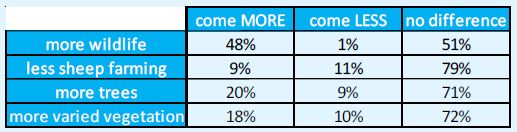
  • What effect would changes in the landscape have on people coming to the Lakes:
    Questionnaire responses to how changes in landscape would affect how often people chose to come to the Lake District

    Questionnaire responses to how changes in landscape would affect how often people chose to come to the Lake District

    So what would we like to see it as in the future? More wild, more managed, more for wildlife or more for cultural landscapes, local livelihoods or historic significance…

  • “for Monbiot this may be bowling greens with contours… for other people it gives them an enormous sense of liberation, of spiritual refreshment, wonderful views, highly complex sheep farming systems… they come to see lambs skipping in the fields, and pretty houses and the mountains “
  • “rewilding is happening in patches all over the place… by the end of this year we will have planted 15000 trees – it’s happening!”
  • “here, if you don’t like open fells, with 1cm high grass, then don’t come”
  • “people should be able to come here and see white tailed eagles and… have that sense that they are coming to a special place and not just… another slightly nobblier version of the countryside”

These are all powerful and inspiring images of what is, could and should happen in the Lakes, but, can they all happen together? Tomorrow… its not what you do, its the way that you do it…

Posted in Lake District Project, The Environment | Tagged , , , , , , , | Leave a comment